
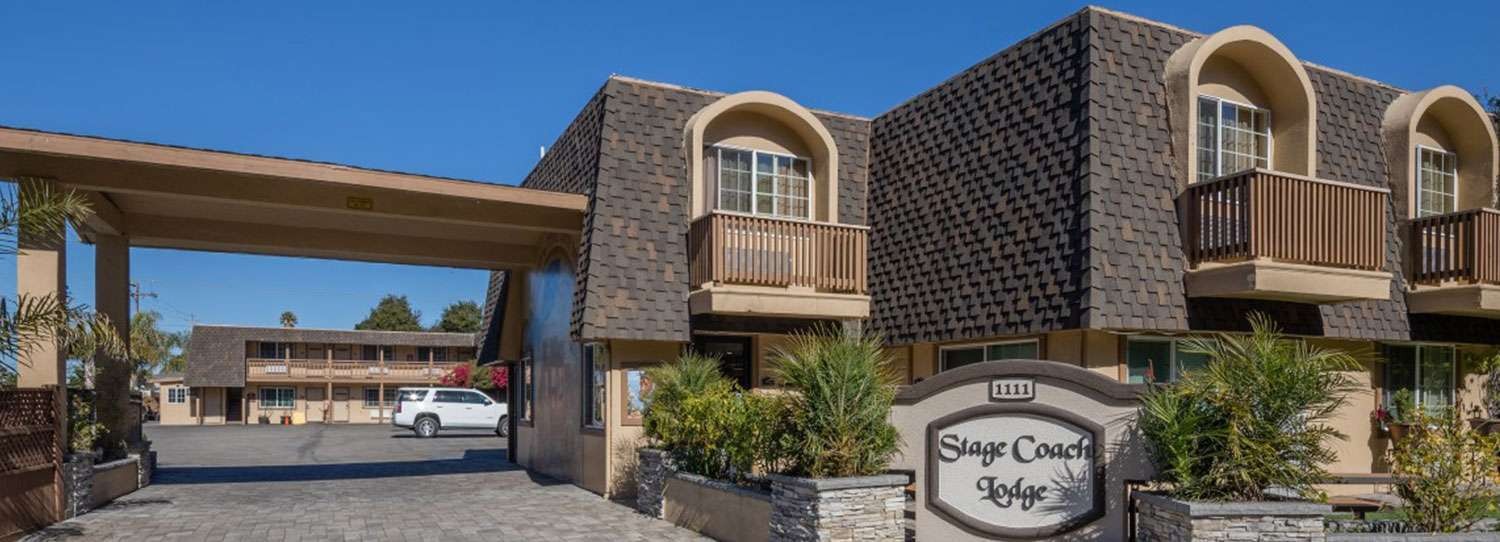
Stage Coach Lodge

1111 Tenth Street Monterey, California 93940 USA

Phone: (831) 373-3632   Reservations: (877) 899-6609   Fax: (831) 648-1734

5915 o F | C Wed
(Clear)
Thu
468/6116
Fri
489/6116
Check Availability Check In Check Out 1 room, 2 adults, 0 children

Monterey California Attractions & Destination Guide

Monterey

Monterey Peninsula offers the vacation experience of a lifetime.  The Monterey Peninsula has a beauty that entices visitors from all over the world. Monterey is located along the central coast of California about 120 miles south of San Francisco. The Monterey Peninsula is one of the most scenic areas of the world offering great ocean vistas and the famed 17 Mile Drive, a coastal toll road that offers breathtaking views of the bountiful Pacific Ocean and the rolling green hills of the world famous Pebble Beach and Spyglass Golf Courses.

Monterey is also home of the world's largest sea life exhibit, the Monterey Bay Aquarium.  Pacific Grove, host to one of the oldest working lighthouses on the west coast, comes alive when the monarch butterfly populations migrate through this tiny coastal town.  Carmel offers a picturesque white sand beach and old world charm with its quaint shops.  Spectacular beaches, nine world champion golf courses, historic old adobes, Fisherman's Wharf, infamous Cannery Row, fabulous shopping, and gourmet restaurants all await you.

Filter By

Family
Entertainment
Children
Tourist
Shopping
Romance

Map

Nearby Attractions

Stage Coach Lodge is conveniently located nearby the following attractions. The list of nearby attractions below can be filtered by Type, Name, or Distance.
Sort by:
l

17 Mile Drive

image

The 17 Mile Drive is a scenic road that meanders through Pacific Grove and Pebble Beach, California, much of which winds along the Pacific coastline and passes through world famous golf courses and amazing mansions.  The 17-Mile Drive is actually only 9.6 miles (15.4 km) long, between the entrances at California State Route 1 and Sunset Drive.At the north end, the road originates in Pacific Grove at the intersection of Del Monte Blvd and Esplanade Street which is only a 5 minute drive from The Stage Coach Lodge. The famous portion of 17-Mile Drive then begins a few miles south of this point. The crossing of Highway 68 and 17-Mile Drive marks the entrance to Pebble Beach.From the Sunset Drive/Pacific Grove gate, the 17-Mile Drive runs inland past Spanish Bay, then adjacent to beaches and up into the coastal hills, providing scenic viewpoints where you can see otters playing in the surf or catch picturesque sunsets over the ocean. Travel along the road takes as long as the traveler likes, a minimum of 20 minutes south to Carmel without stops. There are numerous turnouts along the road to stop, take pictures, or get out and stroll along the ocean or among the trees. Visitors receive a map that points out some of the more scenic spots. Chief among the scenic attractions is the Lone Cypress Tree a salt pruned tree which is the official symbol of Pebble Beach and a frequent fixture of television broadcasts from this area. The road also provides access to Spyglass Hill, Cypress Point and Pebble Beach, and other world class golf courses around the community. After reaching Carmel Way, and the exit to Carmel, the 17-Mile Drive then heads northeast to where it eventually terminates at the Highway 68/Highway 1 interchange from where you can quickly head back to our Lodge within minutes.

Carmel-by-the-Sea

image

Carmel-by-the-Sea, often called simply Carmel, is a small city in Monterey County, California which is situated on the Monterey Peninsula.  The small town is known for its natural scenery and rich artistic history and scenic coastal beauty. Early City Councils were dominated by artists, and the town has had several mayors who were poets or actors, including Herbert Heron, founder of the Forest Theater, bohemian writer and actor Perry Newberry, and perhaps its most famous mayor in actor-director Clint Eastwood, who was mayor for one term, from 1986 to 1988.The town is known for being dog-friendly, with numerous hotels, restaurants and retail establishments admitting guests with dogs. Carmel is also known for several unusual laws, including a prohibition on wearing high-heel shoes without a permit, enacted to prevent lawsuits arising from tripping accidents caused by irregular pavement.With its quirky artistry and culture, Carmel offers numerous boutiques, inns, and parks making it a wonderful town to spend an afternoon and stroll.  One of the nicest white sand beaches in California gleams along the Carmel Coast.Carmel is only a short five minute drive from the Stage Coach Lodge.  Simply exit our driveway and hop back onto Highway 1 and you’ll be in Carmel in no time.

Laguna Seca Raceway

image

Mazda Raceway Laguna Seca (previously known as Laguna Seca Raceway) is a paved road racing track used for both auto racing and motorcycle racing, originally constructed in 1957 in between   Salinas and Monterey, California, USA off of highway 68.The name Laguna Seca is Spanish for "dry lake". The area where the track is was originally a lake. The course was originally built around the lake, which has since dried up entirely. An artificial pond has since been added.The current racetrack is 2.238 miles (3.602 km) in length with a 300 foot (91 m) elevation change. It has eleven turns, including the famous "Corkscrew" at Turns 8 and 8A. A variety of racing, exhibition and entertainment events are held at the raceway, ranging from superkarts to American Le Mans racing to music festivals.Major events each year include the U.S. Sports Car Invitational featuring the Grand American Rolex Sports Car Series, Monterey Sports Car Championships featuring a four-hour endurance race for the ALMS, Monterey Historics for classic racecars, and the Red Bull U.S. Grand Prix featuring both the MotoGP World Championship and the U.S. AMA Superbike Series. In 2006, the A1 Grand Prix brought international open-wheel racing back to Mazda Raceway Laguna Seca.Hop on Highway 68 with ease when exiting The Stage Coach Lodge and you can be at Laguna Seca within minutes.

Lake El Estero

image

Lake El Estero is a citywide park in central Monterey.  Originally a salt-water lagoon, its outlets to the bay were cut off because of over flooding. The 24.7-acre (100,000 m2) park has become an estuary to many migrating birds and ongoing improvements have been made into preserving the park.  Lake El Estero offers several activities with its baseball diamond, skatepark, and the world famous Dennis the Menace Park.  Many parks and attractions have been developed in Lake El Estero to attract both tourists and locals. The most popular of these is the Dennis the Menace Playground.The park opened on November 17, 1956. With a variety of children's play areas, the park became a great success.Lake El Estero is also an important ecosystem in and of itself that supports a large amounts of life and is home to a countless number of birds, fish, and plants. Over 300 species of birds live in or pass thru Lake El Estero Park. Many birds migrating south stop at the lake to rest such as the Ring-billed Gull, the Western Gull, the California Gull, the Mud hen, the Black-crowned Night Heron, and the Great Blue Heron. During the summer the Brown Pelican comes in from the south. Many ducks live there year round such as the Mallard.

Monterey Bay Aquarium

image

The Monterey Bay Aquarium is located on the former site of a sardine cannery on Cannery Row of the Pacific Ocean shoreline in Monterey, California. The Aquarium is located in the Lighthouse district of Monterey only a short drive from the Stage Coach Lodge.  The aquarium actually leverages actual sea water via high circulation of fresh ocean water which is obtained through pipes which pump it in continuously from Monterey Bay creating an amazing test tube of sea life on exhibit for all to see.Among the aquarium's numerous exhibits, two are of particular mention: The centerpiece of the Ocean's Edge Wing is a 10 meter (33-foot) high 1.3 million liter (1/3 million gallon) tank for viewing California coastal marine life. In this tank, the aquarium was the first in the world to grow live California Giant Kelp using a wave machine at the top of the tank, allowing sunlight in through the open tank top, and circulation of raw seawater from the Bay. The second exhibit of note is a 4.5 million liter tank in the Open Sea galleries, which features one of the world's largest single-paned windows with large bluefin tuna and numerous sharks darting through the water.Sealife on exhibit includes stingrays, jellyfish, sea otters, and numerous other native marine species, which can be viewed above and below the waterline. The Monterey Bay Aquarium is also one of the very few aquariums in the world to exhibit both bluefin and yellowfin tuna.The Monterey Bay Aquarium is a must-see when visiting Monterey.  A joy for both adults and children alike.  Please inquire with the front desk for tickets and pricing.

Old Fisherman’s Wharf

image

Fisherman's Wharf is a historic wharf in Monterey, California, United States. Used as an active wholesale fish market into the 1960s, the wharf eventually became the tourist attraction it is today as commercial fishing tapered off in the area.Fisherman's Wharf was built by the Pacific Coast Steamship Company in 1870 for the loading and unloading of passengers and goods. The wharf was also used by other commercial operations, and the city of Monterey took ownership in 1913. The wharf was expanded through 1920.The Wharf was constructed in 1926. After World War II, the sardine population in Monterey Bay collapsed. With the fall of the fishing industry, Old Fisherman's Wharf reoriented its business focus toward tourism.Fisherman's Wharf is now lined with great seafood restaurants ranging from casual, open-air clam bars and fish and chip shops, to formal indoor dining with incredible views of the bay.  Along with Cannery Row, Fisherman's Wharf is one of the few areas in Monterey that sells souvenirs, so the restaurants are interspersed with gift shops, jewelry stores, art galleries, and candy shops. Whale watching tours and fishing trips leave from the wharf, and sea lions often sleep on the pilings and are seen frolicking in the water.Old Fisherman’s Wharf is a short 10 minute walk from The Stage Coach Lodge.

Pebble Beach

image

Pebble Beach is an unincorporated community in Monterey County, California with just 4,531 residents and many world famous golf courses.Pebble Beach has seven public and private 18-hole golf courses. Pebble Beach Golf Links, The Links at Spanish Bay, and Spyglass Hill are owned by the Pebble Beach Company and are all public courses. Poppy Hills is also a public course.  Private courses located at Pebble Beach are Cypress Point Club and the private Monterey Peninsula Country Club's two courses, the Dunes Course and the Shore Course. The Pebble Beach Company also owns a nine hole par-3 course in Pebble Beach called the Peter Hay course, and Del Monte Golf Course a few miles away in Monterey, which is the oldest continuously operating course in the Western United States.Several of these courses are widely celebrated, especially Pebble Beach Golf Links. Designed by Jack Neville and Douglas Grant, it is the most famous course in the Western United States, and the only course which has ever beaten Pine Valley Golf Club to top spot in Golf Digest's biennial list of America's 100 greatest courses. Pebble Beach Golf Links has been the site of the US Open in 1972, 1982, 1992, 2000, and 2010.The Stage Coach Lodge, located right off Highway 1 in downtown Monterey, makes a perfect place to stay when visiting the golf haven of Pebble Beach for a round of golf or viewing the professionals when they come to Pebble Beach for Pro-Ams and tournaments.

Welcome to The Stage Coach Lodge. Stay with us! Book it Now!